
Gas boilers are used in most homes for heating and hot water, providing comfortable living conditions. However, their efficiency and safety largely depend on the correct design of the chimney. One of the most important parameters is its height. If the chimney is too short, it may not provide adequate draft, which will lead to the accumulation of carbon monoxide. If the chimney is too high, problems with condensation may arise, which causes premature wear of the system.
Gas boiler repair specialists www.vinnica-remont.com.ua shared these tips to help you understand how to choose the right chimney height and avoid possible problems with your boiler.
Why do you need a chimney?

A chimney is not just a pipe for removing combustion products. It performs several important functions:
- Smoke and gas extraction. During operation of a gas boiler, carbon dioxide (CO₂), water vapor and, in the event of insufficient oxygen access, carbon monoxide (CO) are produced. The latter is deadly to humans.
- Ensuring stable combustion. Thanks to natural draft, fresh air constantly passes through the combustion chamber, which maintains constant gas combustion.
- Reverse thrust warning. If the chimney is not designed correctly, gases can return to the room, creating a risk of poisoning.
How does the height of the chimney affect the operation of the boiler?
1. Insufficient height – weak traction and carbon monoxide accumulation
If the chimney is too short, it does not create enough airflow to exhaust the smoke. This can cause the following problems:
- Impaired traction. When the draft is weak, the boiler does not receive enough air for complete combustion of the gas, which can cause a decrease in operating efficiency.
- Reverse thrust. In adverse weather conditions (e.g. strong wind), flue gases may return to the room.
- Carbon monoxide accumulation. If combustion products are not properly vented, they can remain in the room. Even small concentrations of carbon monoxide are hazardous to health.
- Automatic boiler shutdown. Many modern boilers are equipped with safety sensors that stop the device if there is insufficient draft. This can cause frequent interruptions in operation.
2. Excessive height – excess gas consumption and condensate
It seems that the higher the chimney, the better, but this is not so. Excessive height also has negative consequences:
- Excessive cravings. When the draft is too strong, the boiler operates inefficiently - heat is lost along with the exhaust gases, which leads to increased gas consumption.
- Combustion chamber overheating. Due to too rapid outflow of gases, the boiler heat exchanger may overheat, which shortens its service life.
- Condensation formation. A high chimney cools the gases, which leads to the formation of a large amount of moisture. Condensate contains aggressive acids that destroy the inner walls of the chimney and boiler elements.
What should be the optimal height of the chimney?
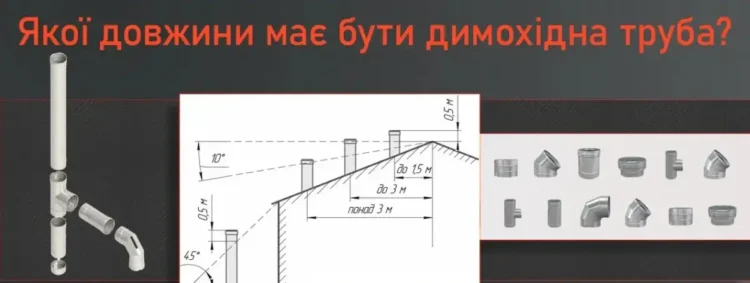
For a gas boiler to work efficiently, it is necessary to correctly calculate the height of the chimney. General recommendations are as follows:
- Minimum height chimney for stable draft – at least 4 meters.
- If the chimney exits through the roof, its upper edge should be:
- Not lower than 50 cm above the roof ridge (if the roof is flat - not lower than 1 m).
- Above all adjacent structures, if they are located within a radius of 10 m.
- For coaxial chimneys (which are used in modern turbocharged boilers) not only the height is important, but also the correct slope of the pipe - 3° towards the street, to avoid the accumulation of condensate.
Additional factors that may affect traction

In addition to height, other factors affect the efficiency of a chimney:
- Pipe diameter. It must correspond to the boiler power. A pipe that is too narrow reduces draft, and one that is too wide contributes to excessive cooling of the flue gases.
- Chimney material. It is better to use stainless steel with thermal insulation, as it is resistant to acidic condensate.
- Number of knees. The more bends in the chimney, the greater the resistance to smoke, which reduces the efficiency of the boiler.
What to do if the chimney does not meet the standards?
If the chimney height is insufficient or excessive, measures should be taken:
- With weak traction You can increase the height of the chimney or install a deflector that improves gas extraction.
- If the pull is excessive, you can install a special draft regulator that stabilizes the air flow.
- When condensation forms The chimney should be insulated or condensate drains should be used.
Conclusion
The height of the chimney is a critical parameter that affects the efficiency and safety of a gas boiler. If the chimney is too short, it can cause poor draft, carbon monoxide accumulation and boiler malfunctions. If the pipe is too high, excessive cooling of the gases is possible, leading to condensation and excessive gas consumption.
To avoid problems, it is necessary to follow building codes and boiler manufacturer recommendations. Regular inspection of the chimney will help prevent problems and make the heating system safe to operate.

